1. Platform#
1.1. Hardware Architecture#

Fig. 1.1 Hardware architecture.#
1.1.1. Heterogeneous Architecture#
The Richie platform consists of an HeSoC, including two hardware subsystems.
The host is a Linux-capable multi-core application-class processor, implementing either:
CVA6, a 6-stage RISC-V CPU (RV64), which is implemented on FPGA;
Arm Cortex-A53 CPU, a hard macro available on Zynq Ultrascale+ MPSoCs.
The device is an accelerator-rich subsystem, hierarchically organized as shared-memory clusters, communicating over a fully-connected AXI-4 crossbar. The L2 memory is implemented as a multi-port, multi-banked instruction and data ScratchPad Memory (SPM).
1.1.2. Cluster Fabric#
The cluster comprises two main sets of components:
data-crunching accelerators, responding to computational requirements;
support devices, supporting through various services, such as programming, storage, communication and synchronization.
The proxy core is a low-cost bare metal \(\mu\)-controller, meant to streamline the supervision of the many HW/SW tasks co-existing inside the cluster, including local accelerator control. It implements the RV32 ISA and fetches instructions from the L2 memory and through an instruction cache.
The L1 memory is a multi-banked, SW-programmable, data SPM, accessible by accelerators and proxy cores via the Logarithmic Interconnect (LIC), a fully-connected crossbar with single-cycle latency and a word-level interleaving scheme to reduce the probability of contention. A Direct Memory Access (DMA) engine is employed for bi-directional, multi-channel and SW-programmable 64-bit data transfers across the memory hierarchies. A strict collaboration with the proxy allows for tight control of the DMA bandwidth. Finally, the cluster includes an Event Unit (EU) to synchronize cores with accelerators, peripherals, other processors, or other clusters, thus allowing the application tasks sequencing by the exchange of 32-bit events signals.
1.1.3. Application-Specific Accelerators#
Accelerators are the primary computational units embraced by Richie inside its device subsystem. Richie adopts the Hardware Processing Engine (HWPE) interface to establish a flexible communication between its accelerators and the cluster components.
An HWPE module is composed of three key components:
The engine implements the datapath, thus is application-specific and operates on latency-insensitive data streams;
The streamer converts the memory-mapped communication protocol of the L1 memory into a data stream for the datapath, and vice versa. It exposes a configurable number of LIC master ports toward the L1 memory to flexibly accommodate application-specific bandwidth requirements;
The controller exposes a memory-mapped control interface for the proxy{} to access and program the HWPE control registers and a FSM implementing coarse-grained accelerator control/(re)configuration.
HWPEs are coupled to the proxy core at the L1 memory level. Their execution is readily triggered by the latter via the exchange of a set of pointers. Multiple HWPEs can be connected inside the cluster, where they share bandwidth with the proxy core and the DMA over the LIC.
Take a look at the HWPE documentation for more information concerning HWPE, its protocol, components, usage, etc.
1.2. FPGA Deployment#
TBD.
1.3. Verification#
TBD.
1.4. Software Stack#
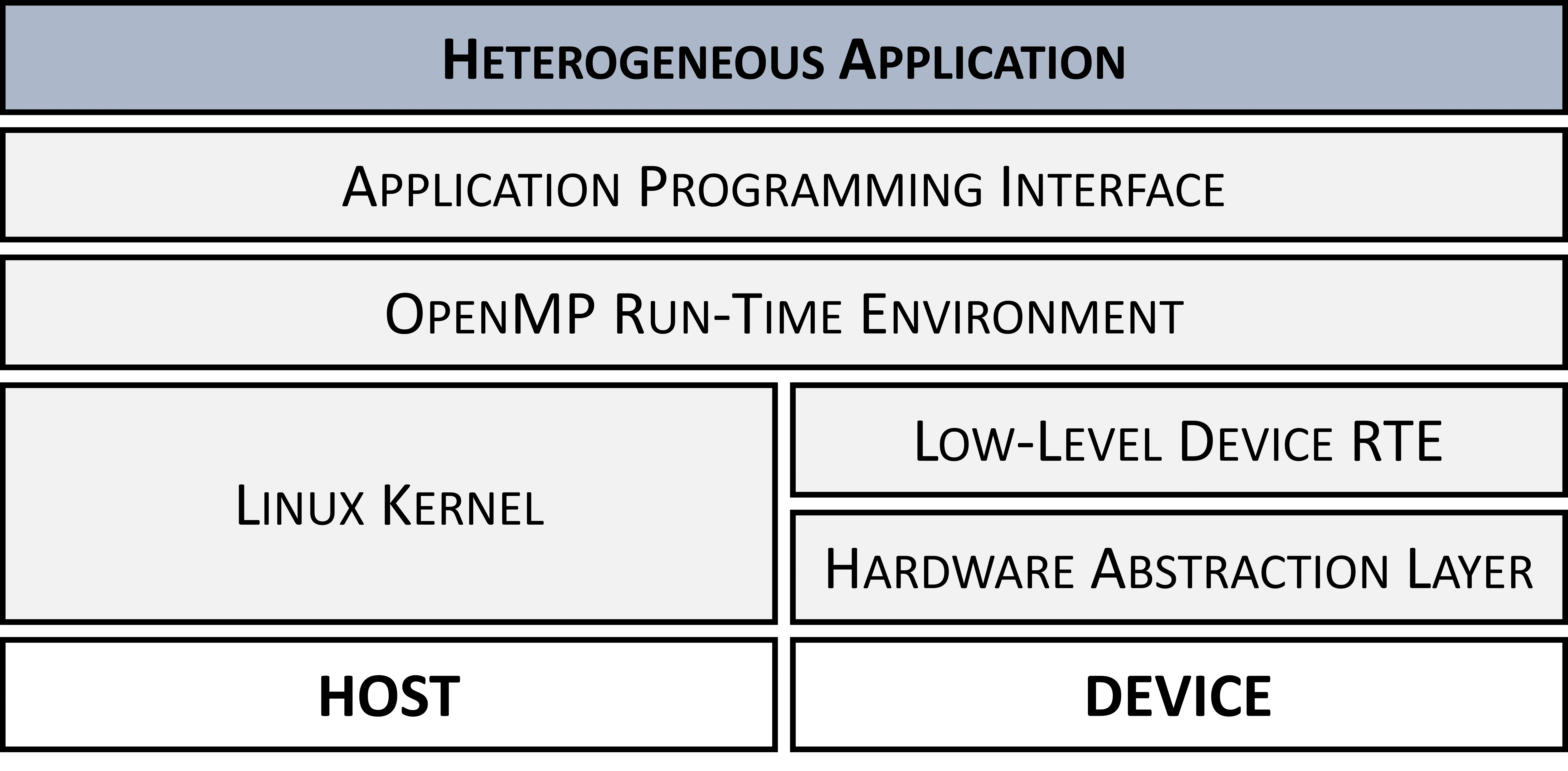
Fig. 1.2 Software stack.#
1.4.1. Heterogeneous Stack#
The Richie platform includes a mature software stack to deploy heterogeneous applications to the underlying hardware subsystem.
The heterogeneous application starts on the host, while the device is targeted via a computation offloading command. The Application Programming Interface (API)` relaxes the interfacing with diverse platforms, easing code portability and reuse. It supports accelerator and DMA control, multi-cluster communication, and memory management.
Host-to-device offloading is supported employing the OpenMP programming model and its Run-Time Environment (RTE). The host invokes a device-specific plugin and provides the device with a pointer to the offloaded code and data. After an initialization phase, the device starts executing.
Besides, an off-the-shelf Linux kernel distribution is adopted to ease the deployment of legacy software on the host, while the low-level device RTE supports the OpenMP constructs, platform-specific routines and functions on the device side. The Hardware Abstraction Layer (HAL) sits on top of the device bare metal and implements optimized primitives and basic functionalities for the underlying hardware.